- ·Finger Painting of the Deaf Taoist School:The Hand BBefore the Brushefore

扫一扫
下载封面新闻APP
体验更多精彩
Finger Painting of the Deaf Taoist School:The Hand BBefore the Brushefore

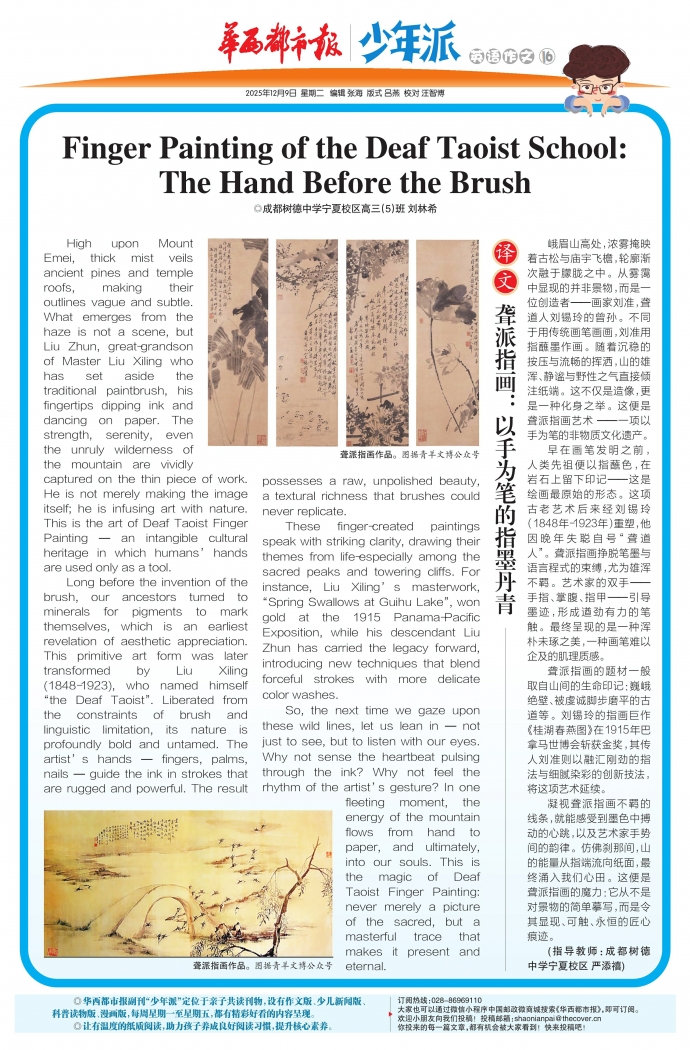
聋派指画作品。图据青羊文博公众号

聋派指画作品。图据青羊文博公众号
◎成都树德中学宁夏校区高三(5)班刘林希
High upon Mount Emei, thick mist veils ancient pines and temple roofs, making their outlines vague and subtle. What emerges from the haze is not a scene, but Liu Zhun, great-grandson of Master Liu Xiling who has set aside the traditional paintbrush, his fingertips dipping ink and dancing on paper. The strength, serenity, even the unruly wilderness of the mountain are vividly captured on the thin piece of work. He is not merely making the image itself; he is infusing art with nature. This is the art of Deaf Taoist Finger Painting — an intangible cultural heritage in which humans’hands are used only as a tool.
Long before the invention of the brush, our ancestors turned to minerals for pigments to mark themselves, which is an earliest revelation of aesthetic appreciation. This primitive art form was later transformed by Liu Xiling (1848-1923), who named himself“the Deaf Taoist”. Liberated from the constraints of brush and linguistic limitation, its nature is profoundly bold and untamed. The artist’s hands — fingers, palms, nails — guide the ink in strokes thatare rugged and powerful. The result possesses a raw, unpolished beauty, a textural richness that brushes could never replicate.
These finger-created paintings speak with striking clarity, drawing their themes from life-especially among the sacred peaks and towering cliffs. For instance, Liu Xiling’s masterwork,“Spring Swallows at Guihu Lake”, won
gold at the 1915 Panama-Pacific Exposition, while his descendant Liu Zhun has carried the legacy forward, introducing new techniques that blend forceful strokes with more delicate color washes.
So, the next time we gaze upon these wild lines, let us lean in — not just to see, but to listen with our eyes. Why not sense the heartbeat pulsing through the ink? Why not feel the rhythm of the artist’s gesture? In one fleeting moment, the energy of the mountain flows from hand to paper, and ultimately, into our souls. This is the magic of Deaf Taoist Finger Painting: never merely a picture of the sacred, but a masterful trace that makes it present and eternal.
译文 聋派指画:以手为笔的指墨丹青
峨眉山高处,浓雾掩映着古松与庙宇飞檐,轮廓渐次融于朦胧之中。从雾霭中显现的并非景物,而是一位创造者——画家刘准,聋道人刘锡玲的曾孙。不同于用传统画笔画画,刘准用指蘸墨作画。随着沉稳的按压与流畅的挥洒,山的雄浑、静谧与野性之气直接倾注纸端。这不仅是造像,更是一种化身之举。这便是聋派指画艺术 ——一项以手为笔的非物质文化遗产。
早在画笔发明之前,人类先祖便以指蘸色,在岩石上留下印记——这是绘画最原始的形态。这项古老艺术后来经刘锡玲(1848年-1923年)重塑,他因晚年失聪自号“聋道人”。聋派指画挣脱笔墨与语言程式的束缚,尤为雄浑不羁。艺术家的双手——手指、掌腹、指甲——引导墨迹,形成遒劲有力的笔触。最终呈现的是一种浑朴未琢之美,一种画笔难以企及的肌理质感。
聋派指画的题材一般取自山间的生命印记:巍峨绝壁、被虔诚脚步磨平的古道等。刘锡玲的指画巨作《桂湖春燕图》在1915年巴拿马世博会斩获金奖,其传人刘准则以融汇刚劲的指法与细腻染彩的创新技法,将这项艺术延续。
凝视聋派指画不羁的线条,就能感受到墨色中搏动的心跳,以及艺术家手势间的韵律。仿佛刹那间,山的能量从指端流向纸面,最终涌入我们心田。这便是聋派指画的魔力:它从不是对景物的简单摹写,而是令其显现、可触、永恒的匠心痕迹。
(指导教师:成都树德中学宁夏校区严添禧)